
Lafayette County Probate Court Records
Lafayette County Probate Court Records usually begin at the courthouse in Darlington, where the Register in Probate, clerk of courts, and register of deeds work together on estate files, guardianship matters, and related property records. The county courthouse directory puts the probate office on the third floor at 626 Main Street, with weekday hours that run from 8:00 a.m. to 4:30 p.m. That makes the local office the best first call when you need a will, a docket trail, or a place to route a records request. The office names are simple, but the record path is clearer when you match the right office to the right file.
Lafayette County Probate Court Records Office
The Lafayette County Register in Probate is the main local contact for probate, estates, trusts, and guardianship matters. The Wisconsin State Law Library directory lists the office at Lafayette County Legal Resources and gives the probate phone line as (608) 776-4811. The same directory also points to the register of deeds at (608) 776-4838, which matters when an estate filing crosses into land records or deed work. For clerk questions, the courthouse contact line is (608) 776-4832, so a narrow request can usually be routed without a second round of calls.
This Lafayette County probate image comes from the State Law Library county page at Wisconsin State Law Library Lafayette County resources.
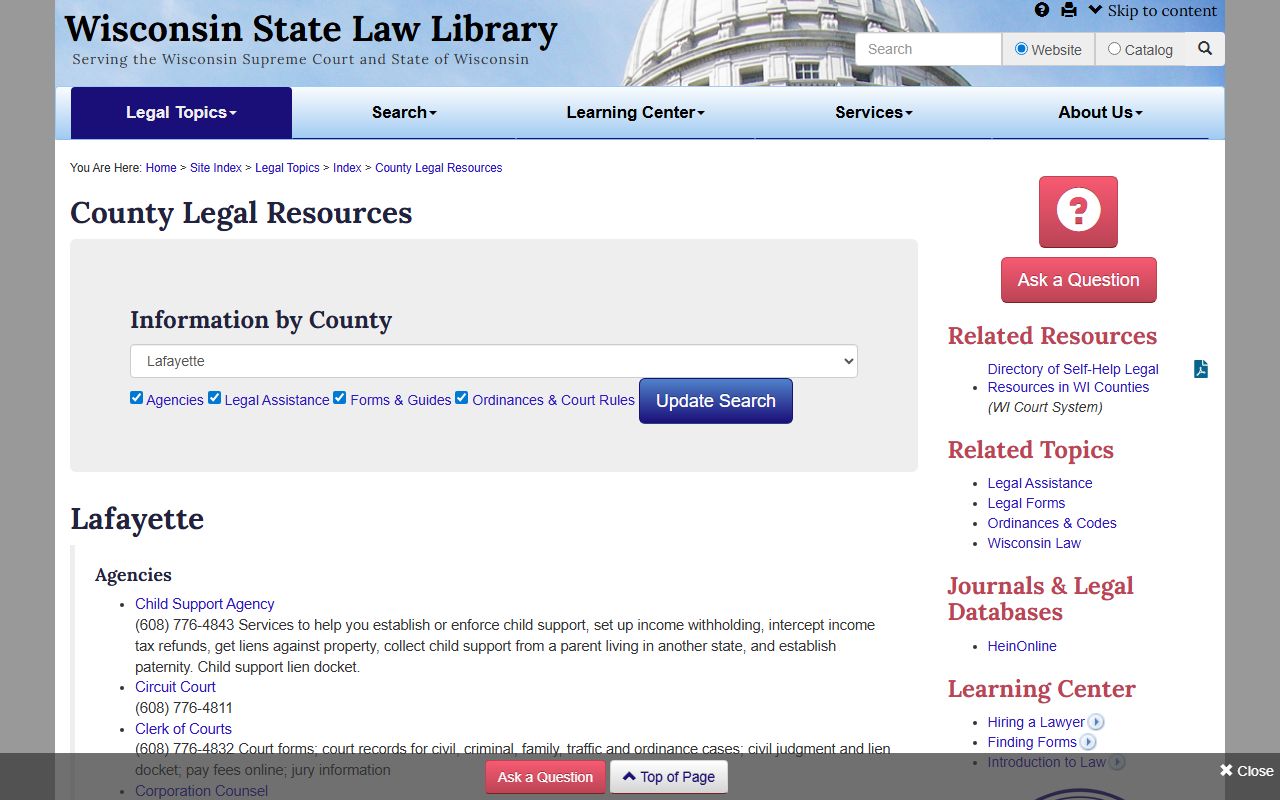
Use that page when you want one official directory that places the probate office beside the clerk and deeds contacts.
This Lafayette County probate image comes from the county homepage at Lafayette County WI.
The county site is the fastest way to confirm the courthouse location, the local departments, and the office structure behind Lafayette County Probate Court Records.
The courthouse directory is helpful because it ties the third-floor probate office to the same building that holds the clerk of circuit court and the law library. When you are chasing an estate file, that matters more than it sounds. A paper copy, a docket question, and a deed follow-up may all sit in different offices even though they share the same address. Starting with the courthouse directory keeps that split from slowing the search down.
How to Search Lafayette County Probate Court Records
WCCA should be the first public tool you check if you want the docket trail behind Lafayette County Probate Court Records. The state case access system gives you the case number, filing history, and status clues that help you decide whether the file belongs in probate, guardianship, or another court track. Once you have that information, the county Register in Probate can move faster because the office can look for the exact file instead of searching by name alone. The county circuit court page also helps because it connects the probate office to the courthouse address at Lafayette County Circuit Court / Register in Probate.
Use the Wisconsin State Law Library county page and the Wisconsin Register in Probate Association directory as cross-checks when you are not sure where the file landed. The law library routing is especially helpful in Lafayette County because it groups probate, estates, trusts, and guardianship contacts in one place. If you are looking for an older file, the same search can also lead you back to a wills filing or a deed reference that sits outside the active estate packet. The county and state tools do not replace the paper file, but they do keep the search focused on the right office.
A good request usually includes the decedent's full name, an approximate filing year, and any case number you already have. If you have none of those, start with the county docket and then ask the probate office to narrow it down. That approach is slower than a case number, but it still keeps the work manageable and avoids broad, unsupported record requests.
Lafayette County Probate Forms and Fees
Wisconsin probate filings use statewide forms, so the best starting point is the official forms page at Wisconsin Court System circuit court forms. The probate index includes informal administration, formal administration, special administration, trusts, and other probate categories, and the self-help guide explains how those packets fit together in practice. Wisconsin also keeps the probate framework inside chapter 852 for succession rules, while the broader probate process sits within the court system's probate materials. That combination is the cleanest way to keep Lafayette County Probate Court Records aligned with the current filing form.
The state fee chart is also worth checking before you file. The circuit court fee table lists probate inventory fees at 0.2 percent of value when the inventory is filed, with a $20 minimum, and it notes that the eFiling fee applies to probate cases. If you need the clerk to locate a single action without a case number, the same chart lists a $5 search fee per action. Those statewide numbers do not replace local guidance, but they do give you a realistic cost picture before you ask for copies or new filings.
This Lafayette County probate image comes from the Wisconsin Court System forms page at Wisconsin circuit court forms.
It is the best official reminder that the probate packet is statewide even when the county office handles the local file.
For practical filing help, the Wisconsin probate self-help guide is useful because it explains the basics of informal estate administration and reminds readers that court staff cannot give legal advice. That matters when you are deciding whether the next step is a probate packet, a copy request, or a docket search. The forms page and the self-help guide work best together, especially when you are trying to keep a request specific to the exact record you need.
Related Deed Records and Property Papers in Lafayette County
Lafayette County Probate Court Records often cross into the register of deeds office when an estate includes real property. The law library directory says the register of deeds handles real estate records and the termination of a decedent's property interest, which is exactly the kind of link that appears when a probate matter affects a parcel of land. The county register of deeds page reinforces that point by showing real estate records alongside vital records and other official county filings. When a probate file involves land, the deed trail can be just as important as the probate docket.
That is where the older property forms become useful. A personal representative's deed may be needed to move title after an estate closes, and a termination of decedent's interest can show why a property record changed hands. Those records do not always sit in the estate packet itself. Sometimes the paper trail is split between the probate office and the deed office, so the safest search order is to check the probate file first and then follow any recorded property document that shows up in the file or the index.
If you are researching an older estate, the combined probate and deed path can save time because many family papers were recorded in more than one office. The county law library page and the deeds page give you a clean way to see that split before you request copies. A precise request, such as a case number or a specific deed type, will usually get you farther than a general ask for everything connected to an estate.
Lafayette County Probate Court Records Access
The best access strategy is to work from the docket to the office to the paper file. Start with WCCA, confirm the case number if you can, and then call the Register in Probate at (608) 776-4811 or the clerk of courts at (608) 776-4832 if you need a copy or a routing answer. The Wisconsin State Law Library county page, the county homepage, and the circuit court page all line up on the same courthouse location in Darlington, so the file path is straightforward once you know which office actually holds the document. For Lafayette County Probate Court Records, that simple order saves time and keeps the request specific.
The Wisconsin probate self-help page is also worth a quick look because it explains the public process and points you back to county staff when the packet needs local handling. If the record is old, check whether the register of deeds has a related land entry or termination record. If the record is newer, the probate office and the docket search are usually enough to get the work moving. The county directory structure is compact, but the record types are not, so the narrowest possible request is usually the best one.
For the cleanest result, include the full name, filing year, and any estate or guardianship case number on your request. If you already know the document name, use that too. A probate office can search much faster when it does not have to guess whether you need a will, a petition, an order, or a deed-related follow-up.